 Last week I had the opportunity to spend five days diving a remote area called Nootka Sound on the west side of Vancouver Island in British Columbia, Canada. You can find a gallery of my photos from the trip HERE.
To most people, the striking thing about cold water photos (such as this "fried egg" jellyfish) is the fact that water in the background is green, not blue like in tropical underwater photos. Camera sensors record green cold waters algaes in more dramatic brilliance than they appear to divers (greens are more "faded" to the diver's eye), but it's certainly obvious you're not in the Cayman Islands!
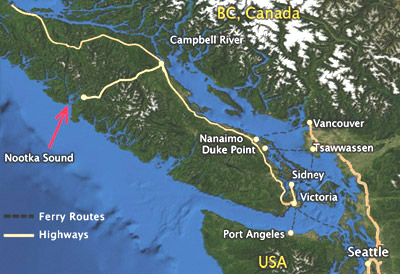 Nootka water comes directly from the Pacific Ocean, and is wonderfully clear, with underwater visibility exceeding 50 feet on most dives. While that isn't terribly impressive compared to tropical locations, where visibility can exceed 100 feet, it is impressive indeed for cold water, and is far greater than typical visibility locally here in Puget Sound. We all wore dry-suits because the water temperature was around 52 on the surface, dropping to around 45 degrees at 100 feet. We dove with Scott and Jude Schooner, a wonderful couple that runs Tahtsa Dive Charters, located in the little village of Tahsis (population 300, and quite literally the "end of the road").
I just recently began trying my DSLR in cold water, and I spent much of this trip fumbling with controls in my dry gloves, but by the end of the trip I was feeling a bit more confident, and I think I'll be able to do better in the future. I also spent almost the entire trip diving with a new "WAM" (wide angle macro) setup--a 15mm fisheye lens and 1.4X teleconverter inside a tiny 4" dome port--and I found it frustratingly difficult to light properly. Still, I was happy with a few of the shots I got, so the time certainly wasn't wasted.
Nootka water comes directly from the Pacific Ocean, and is wonderfully clear, with underwater visibility exceeding 50 feet on most dives. While that isn't terribly impressive compared to tropical locations, where visibility can exceed 100 feet, it is impressive indeed for cold water, and is far greater than typical visibility locally here in Puget Sound. We all wore dry-suits because the water temperature was around 52 on the surface, dropping to around 45 degrees at 100 feet. We dove with Scott and Jude Schooner, a wonderful couple that runs Tahtsa Dive Charters, located in the little village of Tahsis (population 300, and quite literally the "end of the road"). I just recently began trying my DSLR in cold water, and I spent much of this trip fumbling with controls in my dry gloves, but by the end of the trip I was feeling a bit more confident, and I think I'll be able to do better in the future. I also spent almost the entire trip diving with a new "WAM" (wide angle macro) setup--a 15mm fisheye lens and 1.4X teleconverter inside a tiny 4" dome port--and I found it frustratingly difficult to light properly. Still, I was happy with a few of the shots I got, so the time certainly wasn't wasted.

 |
| 30-50 pound salmon spawning - we drifted right through them! |
Speaking of wildlife, one of the highlights of the trip occurred on my final dive of the trip, at a dive site called The Boulders. As I swam slowly along the outside edge of a house-sized rock, a movement caught my eye, and I turned to find a curious adult sea lion swooping and swirling less than 10 feet away! I quickly did a summersault myself ("engaging" dolphins and sea lions often encourages them to stay and "play"), and he/she continued performing for me for about 15 seconds, before zooming off into the distance! Occasional interaction like this with large sea creatures on their "turf" is one of the things that makes diving so rewarding!
If you're interested in more info on Tahsis, you can find an article about this trip in Advanced Diver Magazine online HERE.


No comments:
Post a Comment