Thursday, May 2, 2013

Diving the cold, lush waters of Browning Pass, British Columbia

Walls of sponges, soft corals and anemones.
Last week, I returned from 4 days of diving aboard the Nautilus Swell.  It was both exhausting and inspiring, and the best diving I've ever done in cold water, with reefs that rival the most plush walls I've seen in top tropical spots in Indonesia, Papua New Guinea and the Red Sea!  I see now why this is considered some of the best cold water diving in the world!

Pattern on fish-eating anemone
Browning Pass is known for walls literally covered (not a bare inch in sight!) in soft corals, white plumous anemones and sponges.  But we also saw wolf eels and sea lions (and came across a sea otter and pod of orcas on the surface!).  Unfortunately, my DSLR housing was in the shop for servicing and wasn't returned as promised (Backscatter, I'm not impressed), so all of my photos were taken with a Canon G15 compact camera (in a RecSea housing).  I hate to use that as an excuse, but between a totally different camera/housinng and it being my first diving in a new drysuit and backplate BCD, I didn't get the shots I was hoping for.  Still, the experience was amazing, and I'm very glad I went.

Walls packed with life!
Diving in a drysuit is far more physically demanding than warm water diving; I had to wear 48 lbs of lead just to offset the drysuit's buoyancy, and easily that much more weight in the form of tank, backplate, etc. (compared to 16 lbs of lead in warm water!).  By the time I hit the water for each dive, I (and my Weezle, a down-like drysuit "undergarment") were totally drenched in sweat.  But once in the water, it's all weightless, and the payoff was amazing underwater scenery that made it worth the effort.

The Nautilus Swell departs from Port Hardy (a day's drive/ferry trip from Seattle) at the northern end of Vancouver Island.  The boat is actually over 100 years old, but has been rebuilt from stem to stern since the year 2000, and is really quite nice.  It is a spacious and comfortable liveaboard (note, however, that there were only 11 of us; it would seem far less spacious with its maximum capacity of 20 divers).

A fabulous crew
The 5 crew members, plus Cory and Darrell from Silent World (the Bellevue, WA dive shop that organized the trip), could hardly have been more helpful.  One dive, after my giant-stride into the water, I instantly felt an icy intrusion near my hip--accompanied by a sinking feeling in my stomach as I realized I'd left the last 6 inches of my drysuit zipper open (a mistake you only make once, BTW)!  Captain Chris grabbed me from above, rolled me on my side on the surface, and muscled me into position to close the zipper, and I was able to do the dive (albeit with a gallon of cold seawater making it a semi-dry suit).  After the dive, Cory (from Silent World) offered to take the drysuit to hose it out with fresh water, and Chris then took it to the engine room, where it dried out enough for my next dive. Meanwhile, Claire grabbed the Weezle and ran it through the boat's washer and drier. Earlier in the trip, the shoulder release valve on my (brand new) drysuit seemed not to be working; next thing I knew after the dive, Chris (told by Cory, my buddy on that dive) checked it out, found it faulty, and replaced it with one of his own!  I have other examples, but you get the idea--great crew.

Oh, last but not least, I have to mention Bea, Chris' wife and the ship's cook.  Not only was she sweet, but she made perhaps the best meals of any of the dozens of liveaboards I've been on, complete with a final night's full turkey dinner as good as mom's at Thanksgiving!

All in all, an adventure to remember, and one that has me weighing a return trip to Browning Pass...against a trip to 80 degree tropical waters somewhere...stay tuned!

You can see my full trip gallery HERE.

Sunday, December 30, 2012

North to Alaska!


Top of the world - dog-sledding on a glacier!
A few months ago, Cheri and I took our first real cruise - through the inside passage of Alaska.  In case you're wondering, no, we didn't do any diving.  This was purely a "topside" trip.  What we did see was amazing scenery, a few wild animals, and lots of sled dogs up close and personal!  One of the high points (figuratively and literally!) was a helicopter tour up through seemingly endless jagged mountains to a summer sled-dog camp on a high glacier!
Myself, Cheri, Dick, Minnie, Rick, and Traci - "formal" dinner night, slightly different attire than on SCUBA diving boats!
It was a family vacation; we went with Cheri's family, plus her dad's friend, Minnie.  We first spent 5 days doing a land-based tour from Fairbanks down through Denali National park to Anchorage, and then - after a short visit to the Alaska Animal Conservation Center, boarded the cruise ship - Diamond Princess (more like a floating city than a big boat) to make our way down the inside passage to Vancouver, B.C. (and flew home from there).

Pair of orphaned moose calves at the Alaska Wildlife Conservation Center

The land tour began in Fairbanks, and then we spent nights in three lodges as we made our way South through Denali, with the final leg to Anchorage by train. While on the ship, we saw huge glaciers (Hubbard, Glacier Bay)  where they meet the sea, and later by air.  Like other large natural phenomena (e.g., the Grand Canyon, "Big Sky" country in Montana), photos simply don't do justice to their massiveness and majesty.

Hubbard Glacier - 6 miles wide and high as 3 Statues of Liberty!
One thing I would encourage anyone to do who does an inside passage cruise (at least anyone who's a "dog person") is take the helicopter ride from Skagway up to the summer sled-dog camp atop the glacier.  Just the helicopter tour alone is breathtaking, but you can pay extra to visit the camp and ride around the glacier top on a real sled pulled by Alaskan huskies...and it is so worth it!  It gives you a whole new appreciation for these amazing creatures, and their love for the sport they were bred for.  We will never forget riding across the glacier on top of the world on a sled!

Summer sled-dog camp atop a glacier, dwarfed by nature's grandeur!
Cheri as "musher" and both of us "interviewing" future sled dog team members

You can see my full trip gallery HERE, including other details/photos of the above, and lots more!


Monday, February 20, 2012

Diving WWII shipwrecks in Trug Lagoon

There is something intriguing about the juxtaposition of life growing on relics of death, of nature reclaiming man's grand creations.  I just returned from a week diving the wrecks of Truk Lagoon in Micronesia (to get there from the U.S., you fly to Guam and hang a left).  I've never been a big fan of wreck diving, generally preferring sea life - fish, pelagics (rays, sharks, etc.) and reefs instead.  But Truk's wrecks have been sunken so long now (nearly seven decades) that the wrecks themselves have become artificial reefs.  My goal was to photograph as much life on the wrecks as possible, not just wrecks and artifacts.  Fortunately, I had plenty of opportunities to do so.

Getting to Truk, or Chuuk (rhymes with look) in the local language, is no simple task.  From Seattle, it took me four flights (changing planes in San Francisco, Honolulu, and Guam) and roughly 18 hours, and nearly 24 hours to get home.  But for wreck diving, there's simply no place on earth like it, so the long trip getting there is just part of the "price of admission," as it is many of the world's other best dive destinations.

Home to a Japanese naval fleet late in WWII, dozens of Japanese warships and support vessels were in Truk Lagoon until February of 1944.  A few days before February 18th, a U.S. reconnaissance plane flew over and took detailed photos of the fleet.  The Japanese commander, sensing what that portended, immediately ordered most of his battleships to leave the lagoon and head into the open ocean, where they would be less vulnerable.  Nevertheless, when U.S. forces hit Truk with a massive airstrike dubbed "Operation Hailstone" on the February 18th, dozens of ships remained and were sunken.  Most were huge (400-500 ft) support vessels, merchant marine ("Maru") and cruise ships converted to naval ships for the war, but several battleships remained as well.  The airstrike severed the lifeline that made a fleet base possible, and drove the Japanese permanently from the area.  They also left a graveyard of shipwrecks that has drawn divers from the four corners of the earth ever since.

The bow of a shipwreck, resting slightly askewon the sandy
bottom, is plush with life. The silhouette above is the dive boat.
The picture above, and the one on the right, are two of many I shot on this trip with Canon's new 8-15mm circular fisheye lens, which is capable of capturing a true circular 180 degree view, from straight up to straight down, and straight left to straight right.

I, along with the other 13 passenger/divers - 10 Americans and 3 Brits - lived aboard a dive boat called the M.V. Odyssey.  It is one of the most comfortable liveaboard dive boats in the world (certainly the largest cabins I've ever seen!).  I, and most of the other guests, were very happy with the crew, dive operations and accomodations, although the food was merely "OK" relative to other liveaboards I've been on.  The briefings for each wreck were extensive, preparing us not only with a thorough detailing of each wreck's layout and key points of interest (engine rooms, weaponry, artifacts, etc.), but with its history as well.

This trip entailed the consistently deepest dives I've done, with virtually every wreck in 100 fsw (feet of salt water) or deeper.  I'd say the average depth I reached per dive was 115ft.  Fortunately, we were able to dive nitrox 30 (enhanced air with 30% oxygen instead of the 21% in regular air), which enabled us to remain clear-headed and remain down longer with less risk of DCS (the "bends").  In the nearly 900 dives I've done in the past, I had never had a "deco" dive with required stops before (that's no big accomplishment; it just means I'm a conservative diver...and I'm big so I get low on air before deco becomes necessary).  But I did two deco dives on this trip.  The deepest wreck, with its deck at 165 fsw and cargo holds at 185 fsw, was the wreck of the San Francisco Maru (so named for its maiden port-of-call before the war).  For that, we all dove nitrox 24, but I was still a little "narc'd" (nitrogen narcosis, similar to the nitrous oxide or "laughing gas" you get at the dentist).  But it was the highlight of the trip, with three tanks on the deck and the huge bow gun below.  We all wished we could have dived it multiple times, but unfortunately it was on our last day of diving, so we only dove it once.
Bow gun on the wreck of the San Francisco Maru

Click here to see my entire TRIP GALLERY from this trip, along with some commentary.  All photos in the gallery were shot with a Canon 5D Mark II camera inside an Aquatica housing, with two Inon Z-240 strobes.

I also shot one 4-MINUTE VIDEO with my new (XMAS present from Cheri!) little GoPro Hero2 camera.  This was the first (and last) dive on which I used it this trip, because the flat BlurFix red-filter shattered (at the end point of the video) because I exceeded the lens' approved 100fsw depth! :-O  Fortunately, the GoPro itself remained intact and watertight, so all I lost was the add-on lens.  Nevertheless, the first few minutes of this video give you an idea of what diving on a shipwreck is like!

Friday, September 23, 2011

Diving in the Galapagos Islands


I just returned from a wonderful trip to the Galapagos Islands, where I joined 15 other divers (most of whom I knew from previous dive trips) to experience the amazing life beneath the surface there.  It was great getting back in the water after my recent surgery (see previous blog entry), and what a place to do it!  You can jump right to my PHOTO GALLERY if you want, or you can read the following about the trip. 

Spotted eagle ray swims through a school of hammerhead sharks
Unlike tropical destinations, where divers are attracted by beautiful, colorful coral reefs, the scenery underwater in the Galapagos islands is almost entirely drab, jagged volcanic rock.  The attraction instead is the amazing variety of BIG sea life: we saw dolphins, sea lions, mantas, hundreds of sharks, spotted eagle rays (more than in all my other diving combined), and I finally got to see my first whale shark underwater!  We estimated that it was 30-35 feet long, and being only a few feet away from it was pretty amazing!

Galapagos water temperatures are significantly cooler than other equatorial dive destinations, thanks to a unique confluence of deep water currents that rise to converge in that spot.  Water was particularly cold for our visit, with temps in the mid-50's on many of our dives in the southern islands.  That is similar to summer temps here in Puget Sound, and most of us wished we had brought our dry suits or thicker wetsuits to keep us warmer!  The good news is that cooler water temps seem to bring big sea creatures closer to the surface, so we saw tons of amazing stuff.  Hammerhead sharks, which often stay below 100 or even 150 feet, were plentiful on almost every dive, even at depths of 30-40 feet!

Luke swims through a tunnel of salema
One of the neat things we got to do is swim in/through a school of thousands of black-striped salema.  These little (4-5 inch) fish move in waves, parting to let you swim through, and then closing around you - to the point where the sunlight is blocked and it can be almost totally dark!  We got to see sea lions zoom through the school (feeding), and there were even huge yellow-fin tuna cruising overhead (they also feed on salema).  To give you an idea how salema move in unison, I shot a short VIDEO OF A SEA LION chasing a smaller school of salema at another dive site.

Mansion del Angel in Quito, Ecuador
If you go the the Galapagos, you have to stop in mainland Ecuador en route to the Galapagos (Ecuador owns the islands).  I highly recommend staying at the Mansion del Angel in Quito if/when you pit stop there.  It is a beautiful old mansion, completely refurbished, with excellent service and great breakfast and dinner besides!

I hope you enjoy my photo gallery, and if you haven't visited the Galapagos (even if you don't dive), be sure to put it high on your list.  There's no place else like it on earth!  

Saturday, July 9, 2011

How to Evict Deadbeats and Lose Weight!

My old kidneys: Y1K and Y2K
Three weeks ago, I had surgery to remove both of the kidneys I was born with.  Over the years, they had - due to PKD (see earlier posts) - become increasingly fat, lazy and troublesome.  They no longer functioned, but just got bigger and caused trouble for the neighbors (in this case other organs), sort of like white-trash freeloaders.  In other words, they were deadbeats.  Here's a photo of my two old kidneys; I think you can see why they had to go!

There are three pieces of  good news.  First, my NEW kidney, "Y3K" (Yates' 3rd Kidney), which I got from my friend Sherry Robinson 20 months ago, is doing great.  In fact, it actually appears to be functioning better now that the deadbeats have been evicted!
Back in my college days...

The second piece of good news is that getting rid of those deadbeats resulted in me losing about 15 more pounds (on top of the 50+ pounds I lost after the transplant due to nausea caused by medications)! So I can add a new chapter to my "Easy Y3K Diet Plan" (patent pending)!  Seriously though, I needed to lose all that weight, and I'm thinner than I have been in several decades.  Now I just need to get back in shape...so I can dunk a basketball like I used to!

The last bit of good news is that the surgery went very well.  The two deadbeats were successfully evicted, and the surgeon estimated that they weighed 12 pounds (a normal kidney weighs 1/3 of a pound), so good riddance!  While they were in there, they even took out my appendix, so I never have to worry about getting appendicitis!  It'll just take a while for the internal wounds and the incision in my abdomen to heal (it's slightly over 12 inches long - hold a ruler up to your abdomen and you'll get the idea).  But so far, I'm healing well!  I expect to be back to work next week, and back to normal (if not better!) and back in the water diving, within a couple of months!  Thanks again to all of you who've supported me through this...and the earlier transplant...surgery.  With any luck, I won't need any surgery now for a long, long time!

Saturday, April 9, 2011

Up Close With the Majestic Snow Leopard


I've had to cancel two dive trips already this year due to hectic conditions at work, so my cameras haven't been getting much use lately.  But Cheri and I recently had the extraordinary opportunity to join our friends Doug and Judy for a "behind the scenes" visit at the Woodland Park Zoo in Seattle.  


Judy is a volunteer/docent at the zoo and was awarded this opportunity by virtue of having reached the amazing level of 6,000 volunteer hours!  She was kind enough to invite Cheri and me to join her and Doug for almost an hour behind the scenes getting close to and  talking with the "keeper" of the snow leopards.  We of course were not allowed to actually touch the leopards, but were inches away from them and got to take photos through gaps in the fencing.

I took hundreds of photos, but only felt a half dozen were worth showing anyone, and I've posted those on my website (three on the first page and three more on page 2) HERE.

Stalking behavior (when you're GLAD you're behind a fence)
It was a wonderful experience, and gave us a real appreciation for how far zoos (at least Woodland Park) have come in the treatment, exhibition and conservation of endangered animals like the snow leopard.  I hope you enjoy the photos.  Oh BTW, if you're interested in learning more about snow leopards, or trying to help in the effort to save them, check out the Snow Leopard Trust, the global organization trying to save them from extinction.  It happens to be based right here in Seattle!

Sunday, November 21, 2010

Diving with Giant Mantas - Socorro, Mexico

I just returned from a dive trip to the Revillagigedos Islands (known also as Socorro Islands, after the largest island).  250 miles south of Cabo San Lucas (at the tip of the Baja Peninsula) and a 24 hour boat ride each way out into the Pacific Ocean, these islands are frequented by Giant Pacific Manta Rays, one of nature's most graceful creatures.  These magnificent pelagics have wingspreads of 15 feet or more, and spend their time cruising the open seas in search of plankton, just as whales do.  We saw dolphins and several species of sharks on this trip, too, but giant mantas were definitely the main attraction.  There's a short video I made of mantas HERE (use Back arrow to return to here). Or click HERE to see the entire photo gallery, with captions about the stuff we saw.

Mantas seem to like swimming through divers' bubbles!
Mantas are truly gentle giants, with no "weapons" (no teeth, stingers on their tails, etc.).    They also have no natural enemies, other than big sharks and - in recent years - Asian fishermen, who cut discs from their wings to sell as scallops.  This was my fifth trip to Socorro in the past 15 years, and it remains one of my favorite destinations!  Not only is it one nonstop flight away from Seattle to Cabo, but I never tire of swimming with mantas!

Thursday, October 21, 2010

Y3K (Yates' 3rd Kidney) One Year Update

I'll try to keep this short.  Y3K is doing great!  It's hard to believe that it has been exactly one year today since Sherry Robinson and I lay on operating tables at UW Medical Center and they removed one of her kidneys, carried it down the hall and installed it in me!  Sherry is doing fine; in fact, she and I had our "First Annual" celebratory lunch today, and she's as happy and cheerful as ever!

Back when I was recuperating - with 3 furry friends!
I am extremely fortunate at how well my transplant has gone!  I only have to visit my doctor once every couple of months, I take just 3 little daily handfulls of pills, and my life is pretty much back to normal.  I've managed to keep off the 55 pounds I lost following the transplant (the silver lining for being nauseated for three months)!   I'm trying to take care of myself (I don't smoke, drink, etc.) and avoid getting sick.  Indeed, perhaps the biggest risk to Y3K is that if I caught a really serious infection, it could cause my immune system (which is currently kept sort of "groggy" by drugs) to perk up and get excited - and start attacking everything in my body it percieves as "foreign"...including the new kidney.

Me diving in the Cayman Islands in May (photo by Rick Max)
One of the great things is that I'm able to keep diving!  That was something I worried the transplant might prevent.  It is going to limit how far afield I go (I doubt I'll ever return to some remote, exotic destinations - like Indonesia and Papua New Guinea), but the point is that I do get to continue things I love!

Bottom line: I feel extremely lucky - I have a wonderful wife (Cheri), I'm able to keep working at a job I love (with the greatest co-workers imaginable), I get to continue pursuing my passion for underwater photography (and use it to raise money for a great cause - ICSF), and I have wonderful friends and family who continue to support and care about me!

Tuesday, October 12, 2010

Diving the Cold, Clear Waters of Nootka Sound, BC Canada

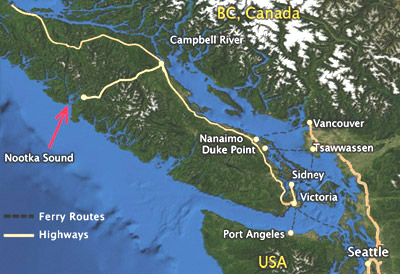
Last week I had the opportunity to spend five days diving a remote area called Nootka Sound on the west side of Vancouver Island in British Columbia, Canada. You can find a gallery of my photos from the trip HERE.

To most people, the striking thing about cold water photos (such as this "fried egg" jellyfish) is the fact that water in the background is green, not blue like in tropical underwater photos. Camera sensors record green cold waters algaes in more dramatic brilliance than they appear to divers (greens are more "faded" to the diver's eye), but it's certainly obvious you're not in the Cayman Islands!  

Nootka water comes directly from the Pacific Ocean, and is wonderfully clear, with underwater visibility exceeding 50 feet on most dives.  While that isn't terribly impressive compared to tropical locations, where visibility can exceed 100 feet, it is impressive indeed for cold water, and is far greater than typical visibility locally here in Puget Sound.  We all wore dry-suits because the water temperature was around 52 on the surface, dropping to around 45 degrees at 100 feet.  We dove with Scott and Jude Schooner, a wonderful couple that runs Tahtsa Dive Charters, located in the little village of Tahsis (population 300, and quite literally the "end of the road").

I just recently began trying my DSLR in cold water, and I spent much of this trip fumbling with controls in my dry gloves, but by the end of the trip I was feeling a bit more confident, and I think I'll be able to do better in the future.  I also spent almost the entire trip diving with a new "WAM" (wide angle macro) setup--a 15mm fisheye lens and 1.4X teleconverter inside a tiny 4" dome port--and I found it frustratingly difficult to light properly.  Still, I was happy with a few of the shots I got, so the time certainly wasn't wasted.

In addition to beautiful underwater life, Nootka Sound is teeming with other animals, as is much of British Columbia.  While boating to and from dive sites, we came in close contact with black bears, sea lions, seals, humpback whales, and sea otters (including this little fellow!).  We also saw bald eagles and many sea birds.  

30-50 pound salmon spawning - we drifted right through them!
One afternoon, we did an unusual "dive."  We took our dry-suits snorkeling in an icy-cold river near Tahsis and photographed spawning salmon; it was amazing floating past hundreds of 30-50 pound lunkers! For more photos, see the link in the first paragraph.

Speaking of wildlife, one of the highlights of the trip occurred on my final dive of the trip, at a dive site called The Boulders.  As I swam slowly along the outside edge of a house-sized rock, a movement caught my eye, and I turned to find a curious adult sea lion swooping and swirling less than 10 feet away!  I quickly did a summersault myself ("engaging" dolphins and sea lions often encourages them to stay and "play"), and he/she continued performing for me for about 15 seconds, before zooming off into the distance!  Occasional interaction like this with large sea creatures on their "turf" is one of the things that makes diving so rewarding!

If you're interested in more info on Tahsis, you can find an article about this trip in Advanced Diver Magazine online HERE.

Sunday, September 12, 2010

Motorcycling around Washington State

My friend Mel and I used Labor Day weekend to take a three-day motorcycle trip from Seattle to see a few parts of our beautiful state. Using the fabulous "Destination Highways - Washington" (a must-have book for anyone planning scenic rides or drives in WA), we managed half a dozen of the state's best riding roads, including two of the top four!


Mount St. Helen (volcano crater)
We started by riding around the East side of Mt. St. Helens (seen here in the distance) from Randle down to Carson, some of the twistiest, most scenic miles anywhere!  I actually got motion sick on the ride up the mountain toward Spirit Lake!

Anyway, from Carson, we rode along the Columbia River awhile, spent the night in Goldendale, and then angled NE through Bickelton (a charming little farm town with a nice historical museum and GREAT $1.50 ice cream cones!) and over into Idaho at Lewiston. From there we went N to Moscow, and then over to Pullman (two college towns) and NW towards home (we planned to take the route through Leavenworth and over the mountains, but unfortunately changed our plan and took I-90 to get home faster)!


I think we too often think we need to go far afield to find great scenic roads, but WA has a ton of them! We only scratched the surface on this little trip!

Thursday, September 9, 2010

First Dives in Puget Sound with DSLR!

Well, I finally took my DSLR (for the first time!) into the cold (50-55 degrees), dark waters of Puget Sound a few days ago.  It was a truly humbling experience. Whereas I feel pretty confident with a camera in warm water, I felt like I was all thumbs inside of my dry gloves - almost no control of camera knobs, etc.  The two dives we did were my first real dives in my drysuit in over a year, so I was struggling with getting "reaquainted" with drysuit buoyancy control as well as handling the camera, and I felt awkward to say the least!  On top of that, visibility was terrible - less than 2 feet on the first dive and about 8 feet on the second.  Not surprisingly, the results were less than thrilling, but I did get a few worth keeping, like the Coonstriped Shrimp above.  If you want to see the others, they're HERE (the half dozen photos after the wolf eel shots are the ones from these dives).

Maldives Traveller article

I've only been to the Maldives (Indian Ocean) once, back in 2001, but I was recently contacted by the editor of Maldives Traveller, who did an online "interview" with me, asking about my experience in the Maldives and for some tips for beginning underwater photographers.  They just published it today, and you can find it HERE (note: this article is no longer available).  Note that my photos, including this one of Pakistani Butterflyfishes, were only 1 megapixel (!) originals, taken with the still feature of my Sony video camera, in ambient light (no strobe).

Friday, August 27, 2010

Videos on Vimeo

I shoot mostly still photos, not video.  But my Canon 5D Mark II camera can also shoot HD video, and I occasionally use that function (e.g., for motorcycle clips, a few crude underwater videos, etc.).  All my videos - including the photo montages I've created with Animoto - are on Vimeo.com, which is similar to YouTube, but without all the clutter and ads. You can find my Vimeo stuff HERE.

Monday, August 23, 2010

What a small world!


Yesterday, to help "promote" my photography to raise money for ICSF (see link in the right margin), I issued a little "press release" (using PR.com) about my appearance last week on Evening Magazine.  Less than an hour later, I got an email from a reporter in London, and a few hours later, one from an editor in the Maldives (Indian Ocean).  How amazing that two people on the other side of the world responded mere minutes after something was issued from Seattle!  That's the power of the internet!

Although I have concerns about internet security, the truth is that I've made some great friends by participating in forums for activities like photography, SCUBA diving, and motorcycles. Some of those people live across the country - or even in other countries - and when I've finally gotten to meet them in person, I feel like I already know them!

Speaking of friends, I was recently contacted by email by two old friends - Ron from college and Rick from childhood days.  These are friends with whom I've had no communication for over thirty years, and both of them just happened to come across my email while tinkering around on the internet!

Before email, my siblings and I sometimes went for years between contacts - all busy with our own lives, and seldom even talking on the phone.  But we now communicate by email almost every week, sometimes several times a day!  I feel like I'm always "in touch" and have grown closer to them as a result.

So...as much crap as there is on the internet, I see the positive side, too - it's a tool for establishing, re-establishing, maintaining and even improving relationships!

Saturday, August 21, 2010

Photo Exhibit at Clyde Hill Tully's


I encourage any of you in the Seattle area to stop into Tully's at  8805 Points Dr. NE in Clyde Hill (just off Hwy 520 on the East side of Lake Washington).  They have a group of special prints of my photos by Prestige Graphics (the same firm that produces the prints for Smithsonian exhibits!). They're by far the best quality prints I've ever seen!  One of the cool things is a 5-foot high print of my grinning shark; it is an exact replica of the one that was in the Smithsonian Nature's Best Photography exhibit for 6 months last year. 
It has been really fun seeing/hearing how much people are enjoying this exhibit, and it was featured in the Evening Magazine segment referenced in my previous post below.

Thursday, August 19, 2010

My TV Debut!


Here's a link to a TV segment about my underwater photography on Seattle's Evening Magazine last night: CLICK HERE (Click "Native" at top when frame opens. Segment starts after a 1-minute intro.) If that doesn't work, try the lo-res version on King TV's website HERE.

I was really self-conscious (being my first time on TV), but I think they did a nice job, and I was happy that they mentioned ICSF by name - hopefully that will garner some donations! Of course, they only used a few short "sound bites" out of the hour-long interview they did with me (I talked about Nature's Best Photography, the PKD Foundation, shark fin soup and shark conservation, and tons of other stuff), but I realize that in a few minute story, most of it had to be left out.

Just for the record, I did NOT suggest "staring down" sharks! I simply said that, with small sharks, often if you just looked straight at them, they will veer away because they seem able to recognize your eyes (I guess they felt a need to spice it up a little!). ;-)

Tuesday, July 20, 2010

Animoto videos (montages of photos)


I've been experimenting with a website called Animoto.com, which lets you easily construct videos and put generic music with them (30 second videos with up to 15 photos are free, whereas longer ones like the ones below have a cost). Here are four I made from my still photos.  They range from cute (our dogs and clownfish) to less cute (mantas and sharks). If you watch one, click the four-corner icon at the bottom right (for Full Screen)!
Four Great Dogs

Monday, July 19, 2010

How I came to Support ICSF

A burn victim, before and after ICSF surgery.
It's interesting how a chance encounter can result in a lasting relationship.  Most of you know that I donate the profits from my photography to the International Children's Surgical Foundation.  What you don't know is how that came to be.

A few years ago, my oldest brother, Roger, was unconscious and literally on his death bed in his apartment in Boise, ID.  My sister Margo and I were able to go and sit with him that last week of his life.  During that time, a number of Roger's friends came by to pay their respects, bring us meals, and keep us company.  Two of them were Geoff Williams and his mother, Bev.

Both Bev and Geoff considered Roger a dear friend.  Bev was one of my mother's friends, and got to know Roger during those years, and stayed in touch with him after my mother's death.  That connection led to Roger and Geoff becoming friends as well.

Well, Bev and Geoff came and spent hours with Margo and me in Roger's apartment, and in the course of those conversations we discussed our lives...and theirs.  I discovered that Geoff graduated from high school the same year I did, and he and I played basketball against each other (I grew up in Boise) for our respective high schools.

At some point in our conversations, Margo and I learned that Geoff had given up his practice as a plastic surgeon, and spent most of his savings, to establish ICSF.  He did so after an experience in Viet Nam with hundreds of mothers and their children with facial deformities. It so touched him that he decided it was his life's calling to help children like that.  Through ICSF, he now leads teams of physicians and nurses to lesser-developed countries all over the world performing facial surgeries and teaching local physicians how to do the same.

Bev, meanwhile, who thought she had long since "retired," became the secretary and treasurer of ICSF, and "runs" the day to day operation of ICSF from a small room in her home (Geoff lives there when he's home in between missions).  Neither of them takes any salary, and they scrimp and save (Geoff drives a 20-year-old Toyota) so that every possible penny can go towards ICSF's work.

After Roger died, Margo and I suggested that people who wanted to donate money in his memory give to ICSF.  We did so not only because Bev and Geoff were such good friends to him, but because we were so touched by their selfless dedication to such a wonderful cause.

Later, as I was thinking of where I should donate money from my photography (I made the decision years ago that I would give any profits to charity), it occurred to me that I had traveled to and taken pictures in many countries like those ICSF served, and had seen the beautiful children in those places, and knew how impossible it would be for them to pay for surgery of the type provided by Geoff and his teams.  By performing those surgeries for free, ICSF literally gives those children a chance at a normal life.  I couldn't think of a more worthy endeavor to support.  So that's what I've done ever since.  As an example, I placed the ad below in an underwater photography magazine as "payment" for an article I wrote:
The ad I was able to get in Underwater Photography magazine in lieu of compensation for an article I wrote for them
I encourage you to visit the ICSF website.  I think you, too, will be touched by what they do.

Y3K (Yates' 3rd Kidney) - 6 month update


April 21, 2010 was Y3K's 6-month anniversary!  This should bring anyone interested up to speed on my kidney transplant.  (BTW, unless something unusual happens, the next update will likely be in October - around the 1-year mark.)

The short story is "Y3K is doing great!"  My wonderful doctor at UWMC (Dr. Kim Muczynski, who I now only have to go see about every 2 months) says everything is going perfectly - that I could be the poster child for what successful transplants look like!  In fact, some of my blood numbers are the best they've been in more than ten years!  So needless to say, I am feeling very lucky indeed!   Sherry R. (Y3K's previous "owner") is also doing great, and Cheri and I get to spend time with her and her husband Mel regularly.

6 months was a significant milestone, in part because I got to drop some more pills...thus far, I've been able to drop about 1/3 of the original pills I was taking (I'm down to "only" about 40 a day), and I am having far fewer side effects than before.  And, of course, the longer my body goes without rejecting the new kidney, the more likely it will continue to be a hospitable host!  

One of the good side effects of my medications is that--in conjunction with the fact that my old deadbeat (polycystic) kidneys keep growing and putting pressure on my stomach--I tend not to be as hungry.  So in the first 6 months after the transplant, I lost about 50 lbs!  If I lose another 10-15 lbs, I will hit my "ideal" weight, at which point I'll actually need to start forcing myself to eat more to maintain that level!  (For anyone who knows me well, the idea of me having to force myself to eat is slightly hilarious!) 

Anyway, I've been super busy at work (I've been working full time since about a month after surgery!), without much time for anything else.  However, I went on my first Y3K dive trip--on Grand Cayman (1 week of really easy diving)--with Rick and Traci in May.  All went well, and in November I head back to Socorro (for the 5th time) with a bunch of friends.  It is great to be getting back in the water after a year!

I'll be avoiding more exotic destinations (e.g., Indonesia and Papua New Guinea) for at least a few years because one thing that could trigger my body to reject Y3K is a serious infection, and countries like that have lots of diseases just waiting for visitors.  In fact, even though those are some of my favorite places, I may never get to go back for that reason, unless my doctor is totally comfortable that it's safe.  If not, I can live with that; it's a small price to pay...and there are plenty of other places to dive/visit.

Several people have asked me if I feel differently about diving, or riding my motorcycle, than before the transplant.  The answer is "yes."  It's not that I feel I should give up those activities, but I feel a need to be a bit more cautious in the WAY I do them.  I haven't exactly been a wild man in the past, but it's a little like when you're driving someone else's child around in your car - you might drive just a little more carefully because you're aware of being "responsible" for them, and taking good care of them.  I feel a little like that - like maybe I need to hang one of those little yellow diamond-shaped signs on the back of my motorcycle that says, "Kidney on Board!"  ;-) 

Well, that's enough rambling for now.  As I've said before, I truly appreciate all of the kind wishes, inquiries and thoughts everyone has sent me.

First Blog Post

Up to this point, I have assiduously avoided joining "social networking" sites (Facebook, etc.) because of privacy/security concerns. I suppose this blog could be viewed as opening the door to that realm, but I'm hoping it remains mostly a forum for communication with friends, family and like-minded strangers (sometimes strangers can end up becoming quite good friends!).

BTW, I created this blog using Google's free blog site: www.Blogger.com .